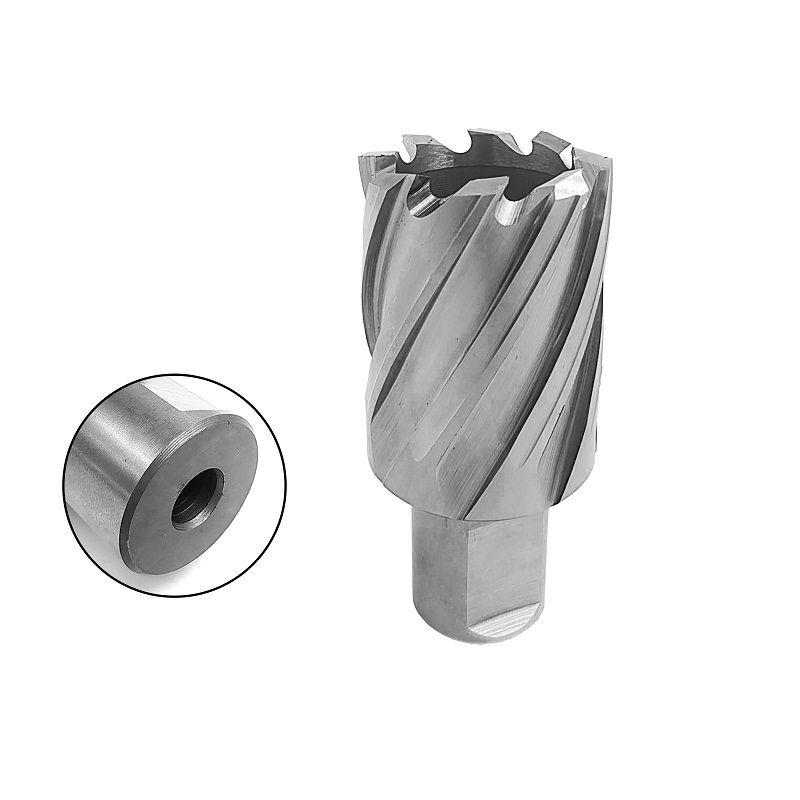
An HSS annular cutter with Weldon shank is the go-to tool for drilling large holes in steel plate and structural beams. Here’s what buyers need to know—features, advantages, and answers to the three most common questions.
Key Features
3/4″ (19.05 mm) Weldon shank – two-flat design locks securely into standard mag drill arbors, preventing slip under load
M2 HSS cutting edges – hardened for mild steel, structural steel, and aluminum
Hollow annular geometry – cuts only the periphery, leaving a solid slug and eliminating pilot drilling
Integrated pilot pin – centers the cut and channels coolant to the teeth
12–60 mm diameters, re-sharpenable – covers most fabrication needs and extends service life.
HSS vs. TCT Comparison
| Features | HSS Annular Cutter | TCT Annular Cutter |
| Material | High speed steel | Stainless, hardened carbide alloys |
| Cost | lower | higher |
| Strain on mag drill | lower | higher |
Core Advantages
- Massive time savings– cuts a ring instead of the full diameter; no pilot hole or step-up sequence.
- Lower power demand– lighter mag drills handle larger diameters comfortably.
- Clean, accurate holes– rigid Weldon lock and pilot pin deliver concentric, burr-free results.
- Solid slug, less swarf– the core pops out as a reusable slug, keeping the workplace cleaner.
3 Buyer Questions Answered
- Will the Weldon shank fit my magnetic drill?Almost certainly—3/4″ Weldon is the industry standard for portable mag drills in the 12–60 mm range. Verify your arbor size first; some cutters above 60 mm use 1-1/4″ shanks.
- Is HSS enough, or do I need carbide?For mild and structural steel, HSS is the cost-effective workhorse. For stainless or hardened plate, step up to TCT—HSS teeth wear quickly there.
- Why do cutters break teeth?Usually speed or feed, not the cutter. A 3/4″ cutter in mild steel wants 450–550 RPM; 1-3/8″ drops to 250–350 RPM. Run coolant through the pilot pin hole and never cut dry.